
Deep ruby color; cherry, raspberry, plum, pomegranate, black pepper, herbs, spice on the nose and palate.
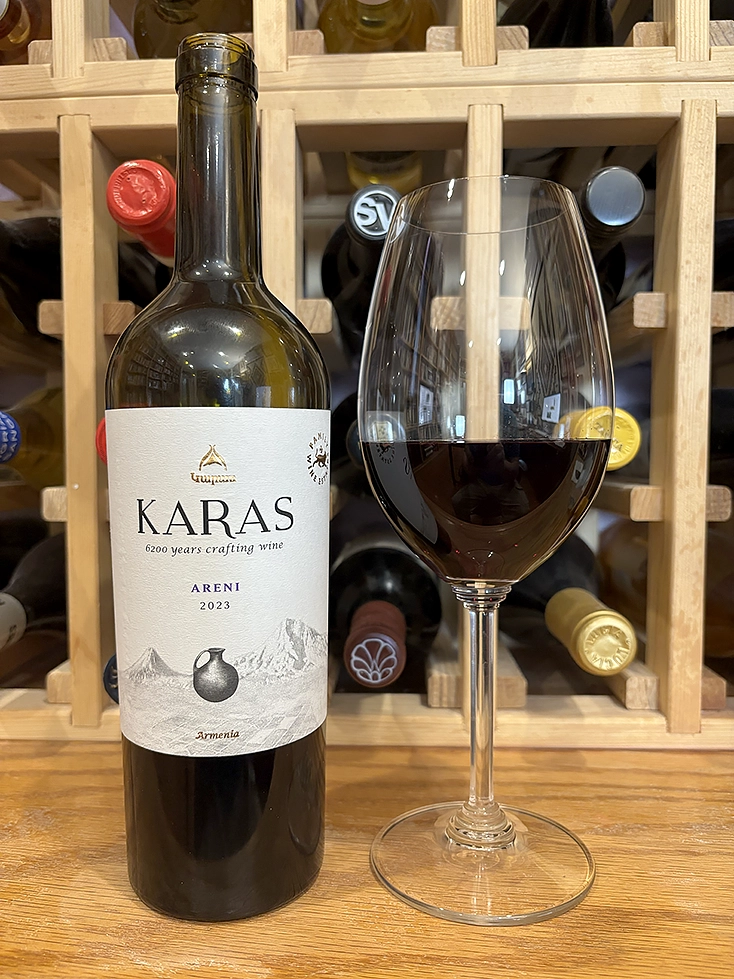
Dry; moderate, firm tannins and acidity. Medium body. Smooth easy drinker. Areni is the ancient, premier indigenous red grape of Armenia with a taste profile falling between pinot noir and sangiovese. Grapes are manually harvested, followed by temperature controlled maceration and fermentation in traditional classic amphora (karas, thus the winery name), then malolactic conversion in stainless steel, followed by 14 months aging in Armenian oak. You are drinking wine produced from a revived wine culture dating back more than 6,200 years. Well worth a try. 13% ABV
Armenia is located at the nexus of Europe and Asia, with Georgia—the birthplace of wine—to the north, Turkey to the west, Azerbaijan to the east, and Iran to the south. That is a rough neighborhood, but it and its wine industry is recovering from the misery and dumbing-down of Soviet Union occupation. Like Georgia, the Soviet state insisted on mass production of low-quality wine and brandy. Like Georgia, winemakers took the long view, hunkered down with the hope this eventually would be over. Now it is over. Let us rejoice and be glad.
Due to the isolation of Armenia’s primary wine region, many vines grow on their own roots. Grafting is not needed because the phylloxera louse never reached Armenia’s high-altitude vineyards. Vineyards are located at 2,800-5,700 feet, competing with high altitude vineyards in Chile and Argentina. The soil is a mix of volcanic rock and limestone, providing excellent drainage and a mineral backbone. Summers are hot, winters are very cold. In the growing season, there is significant diurnal shift (hot days, cool night), a signature of quality wine regions.
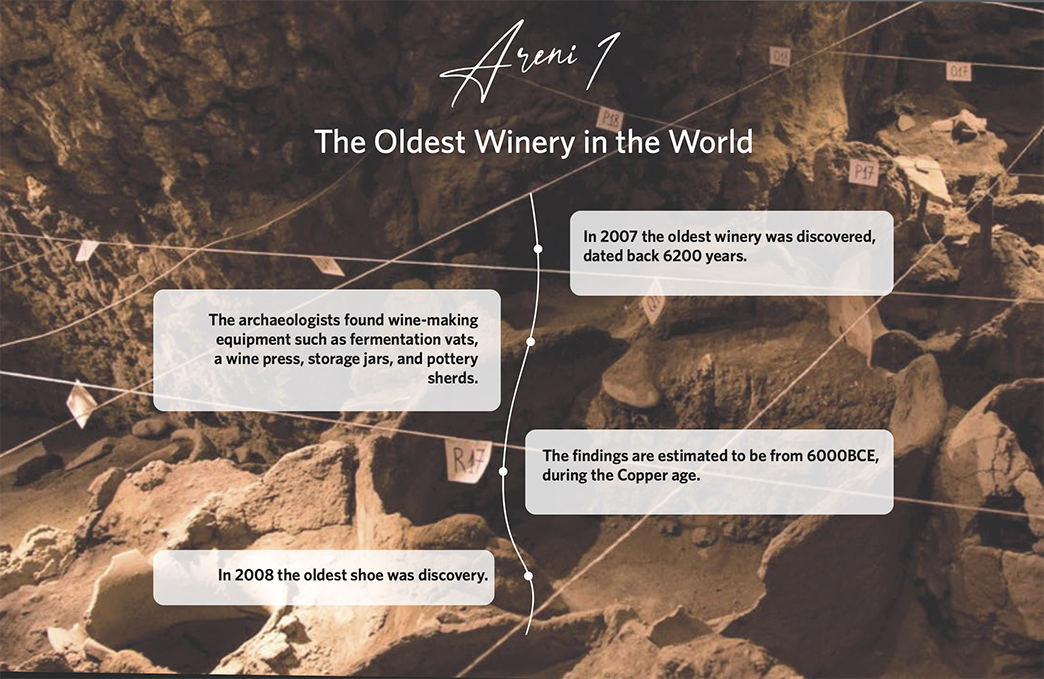
In 2007, archeologists discovered the Areni-1 winery complex in a cave above the Arpa River that dates to 4100 BCE. It is the world’s oldest known winery. The site contains fermentation vats, a wine press, storage jars, and desiccated grape seeds identical to modern areni noir grapes—the grapes used to make this wine. With this wine, you are drinking wine people drank at the beginning of the Bronze Age, the early stages of the use of the plow and irrigation agriculture in the “cradle of civilization” along the Tigris and Euphrates river, the beginning of the construction of large ritual monuments. Ahem, ponder that as you sip a quality wine for under $20.
The winery is project of Eduardo Eurnekian, an Argentine billionaire businessman of Armenia heritage—he is the fourth-richest person in Argentina. He works alongside his niece, Juliana Del Aguila Eurnekian, who is the owner and president of Karas Wines. She studied psychology at the University of Buenos Aires, trained as a sommelier, and completed the owner/president management program at the Harvard Business School. She splits time between Armenia and Argentina, where she leads Bodega Del Fin Del Mundo in Patagonia. The pair brought in renowned French oenologist Michel Rolland as a consultant to develop Karas. The head winemaker is Gabriel Rogel, and Argentinian who moved to Armenia to lead the winemaking effort. The winery operates more than 500 acres of vineyards and employs more than 500 people.

The winery is near Mount Ararat, which is two dormant volcanoes, one the highest peak in Turkey, the other—Little Ararat—is on Armenia’s border. Ararat appears on the coat of arms of the Republic of Armenia. Turkey and Armenia consider Ararat as a shared regional landmark. Many Christian and Jewish traditions associate the twin mountains as the specific mountains mentioned in Genesis as the final resting place for Noah’s Ark. Armenian tradition casts Armenians as descendants of Hayk, the great grandson of Noah.
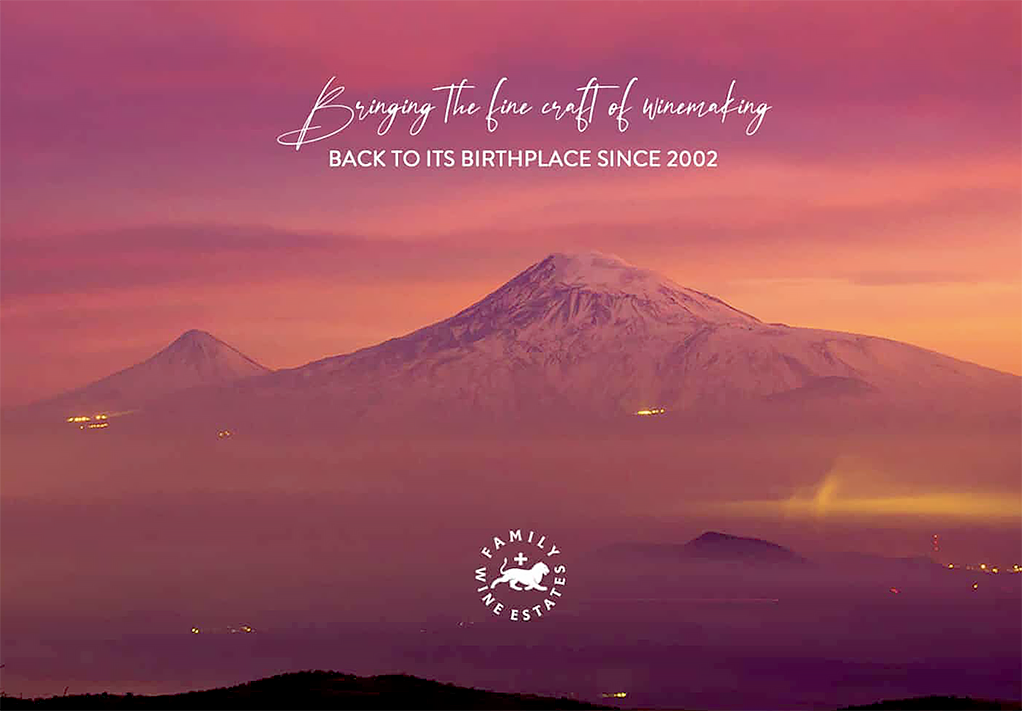
Karas Areni, Armenia 2023 checks an amazing number of boxes in the wine world. First, it is a delicious wine that sips in a space between pinot noir and sangiovese. Second, archeological finds discovered evidence of this very grape dating back 6,100 years and the first clearly identified winery in the world. The winery is in the shadow of Mount Ararat, believed by Christians and Jews as the possible location of Noah’s Ark. You get to drink history, the very beginnings of wine, and drink superb wine. And do so for $16-20.
Pairing—Grilled and roasted lamb and beef, particularly traditional Armenian khorovats (grilled meats). Braised lamb shanks with apricots, roasted lamb with root vegetables. Turkey and traditional Thanksgiving fare. Duck confit. Grilled vegetables, particularly eggplant-basec preparations such as imam bayildi. Pasta dishes with mushrooms and herb-based sauces. Cheese—Hard Armenian cheeses, chechil (string cheese), brynza (mild, creamy sheep’s milk cheese), lori. White cheddar with cranberries, young cheddar, gouda, monterey jack; brie, camembert, feta, morbier; aged gouda, manchego, gruyère, pecorino.